Originally written: May 2026
Theory of Spheres' ('Quantum Gravity')'
or
'E'Empty Spheres in Dimensionless Space' – The 'Fundamental Force Behind Everything
(.Q('Quantum – Gravitational Force', 'Dark Matter' / 'Dark Energy', etc.)
Paper Ⅴ: The sphere's boundaries – Maximum speed of light and the universe Lifespan
Eran Shimony (ORCID number – 0009-0003-5610-6736)
Physicist (B.Sc.), MBA, and Certified Real Estate Appraiser
i
Download the complete research papers in PDF format for offline reading and citation:
[Download Article I: The Framework (PDF)]
[Download Article II: The Spheres Classical components (PDF)]
[ Download Article III: The Quantum–Gravitational Force as Derived from the Spheres (PDF)]
[Paper III(a) – Updated version: The Quantum–Gravitational Force as Derived from the Spheres (PDF)]
[Download Article Ⅳ: The Planck's constant – ℏ (PDF)]
[Download Article VII: Introduction to the New Quantum Geometry Formalism (PDF))]
[Download Article IX: Introduction to the New Quantum Geometry Formalim (PDF))]
i
Publication History & Context: This article was published on May 16, 2026 (DOI: 10.17605/OSF.IO/42THF).
It builds upon the foundational theory established in the previous work: 'Theory of Spheres – Part I', published on December 29, 2025 (DOI: 10.5281/zenodo.18081185)
and upon the 'Theory of Spheres – Part II' published on February 01, 2026 (DOI: 10.5281/zenodo.18446035).
J
ABSTRACT
This paper provides the definitive numerical boundaries of the current cosmic universe oscillation within the Theory of Spheres (ToS) framework. By applying the Heisenberg Uncertainty Principle to the universal energy-mass distribution, we derive the fundamental temporal and velocity limits of our universe. We demonstrate that the theoretical lifespan of the first cosmic quadrant is about 360 billion years, positioning our current epoch (14 billion years) in the absolute infancy of cosmic evolution—equivalent to a child between 3 and 4 years old. Furthermore, we derive the maximum speed of light (Cmax) at the point of equilibrium, reaching a value of ~0.5 pc/sec (1.76 x 10¹³km/sec). These findings provide a consistent geometric resolution to the expansion rate and the long-term evolution of space-time.
Part A: Introduction
The Theory of Spheres (ToS) has previously established that the fundamental constants of nature are not static values but evolving geometric properties of a zero-dimensional (0-D) harmonic oscillator. While earlier papers in this series focused on resolving the Hubble Tension and defining the nature of the vacuum, Paper Ⅴ aims to quantify the physical boundaries of the sphere’s expansion.
In modern cosmology, the lifespan of the universe and the constancy of the speed of light remain subjects of significant debate, often leading to paradoxes such as the 'Vacuum Catastrophe' – dealt with in earlier paper. This paper addresses these dilemmas by treating the universe as a structured, oscillating geometric entity.
We begin by utilizing the quadratic coupling of the 0-D oscillator to derive the maximum timeframe (tmax) of the current cosmic quadrant. Subsequently, we apply this timeframe to the evolution of light speed to determine its peak velocity (Cmax). By establishing these numerical limits, we provide a cohesive roadmap for the universe’s progression toward equilibrium, laying the groundwork for a dynamic understanding of mass and relativity in future works.
Chapter 1: Deriving the Maximum Lifespan of the Universe (tmax)
The Uncertainty Principle as a Cosmological Boundary
In the framework of the Theory of Spheres, the universe is not an infinite expansion but a finite geometric entity governed by quantum pressures. To determine its temporal limits, in a way similar to our derivation of the Cosmic Planck Constant in Chapter 1 of Article IV – we apply the Heisenberg Uncertainty Principle to the entire energy-mass of the universe.

Substituting the total energy of the universe using the mass-energy equivalence E=m∙C(t)2, we obtain:

Integrating the Varying Speed of Light (VSL)
As shown, for example, in Equation 1 in Article III in its general form, our model defines the speed of light C(t) – Normalized to unity for the current epoch – as a time-dependent function linked to the expansion of the spheres:

Combining these equations allows us to express the uncertainty in time (∆t) as a function of the universe's age and its fundamental mass:

And:

The Asymptotic Balance at tmax
As the universe approaches its maximum expansion, the rate of change in the speed of light reaches a saturation point. At this cosmic balance state, the infinitesimal time interval ∆t converges toward the total elapsed time 't'.
By setting the condition t ≈ ∆t, we can numerically solve for t, which is essentially equal to tmax, which represents the theoretical lifespan of the universe.

Or, as 't' approaches tmax:

This value represents the theoretical lifespan of the universe in The First Quadrant, expanding from the starting boundary to the equilibrium point, as established in Chapter 1 of Article III(a). It is derived directly from the geometric constraints and quantum pressure of the spheres.
Numerical Derivation of the Universal Timespan
Consider the following fundamental values:
- ℏuniverse ≈ 8 x1087kg∙m2/sec = 8 x 1087J∙s (As established in Article IV, Chapter 2)
- Muniverse = 1053kg (Baryonic mass only)
- KD0 = H0 = 48.41(km/s/Mpc ≈ 1.569 x 10⁻¹⁸s-1 (As established in Article II, Chapter 1)
i
We define a dimensionless variable, y: y = H0 x tmax
Substituting these into our geometric constraints, we obtain:

And:

Meaning:

Assuming 'y' is sufficiently large, such that ey – 1 ≈ ey, we get:
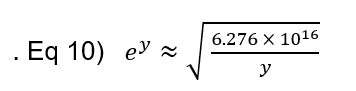
From numerical calculation, we find: y ≈ 17.9
Therefore:

Conclusion:
The theoretical lifespan of the cosmic oscillation within the first quadrant—from the starting boundary to the equilibrium point—is about 360 billion years.
Given that the current estimated age of the universe is approximately 14 billion years, we can conclude that our universe is still in its absolute infancy. Relatively speaking, when compared to a human lifespan, the universe is currently at a stage equivalent to a child between 3 and 4 years old (approximately 4% of its total progression toward equilibrium at the end of this quadrant).
This lifespan, however, is not the full oscillation period back to the starting point, which carries significant physical meaning. The full oscillation period is four times the duration calculated in the chapter—meaning the cycle time for a full oscillation is approximately 1.44 x10¹² years (1.44 trillion years).
Chapter 2: Deriving the Maximum Speed of Light (Cmax)
Following the numerical derivation of the maximum cosmic timeframe tmax, we return to Equation 1 (Uncertainty principle) to determine the peak velocity of light within the current cosmic oscillation.
To maintain consistency, we refer back to Equation 3: C(t) = eK(DO)·t
By substituting the maximum timeframe (tmax ≈ 1.14 x 10¹⁹sec) derived in the previous chapter, we obtain:

Consequently, based on the normalization of today's speed of light to 1 (Cnow = 1, chapter 1 above), we obtain:

Final Conclusion: The New Cosmic Scale
This paper marks a pivotal milestone in the Theory of Spheres (ToS) by providing precise numerical derivations of the universe's fundamental limits. By applying the Heisenberg Uncertainty Principle to the total energy-mass of the universe, we have established a self-consistent framework that defines the lifespan and velocity peak of our current cosmic cycle.
The main conclusions of this study are:
- A Universe in its Infancy: The theoretical lifespan of the first cosmic quadrant (expansion toward equilibrium) is derived as 360 billion years. Given the current age of ~14 billion years, our universe has completed only 4% of its progression, making it equivalent to a child between 3 and 4 years old in human terms.
- The Full Oscillation Cycle: Beyond the first quadrant, the total period required for a full cosmic oscillation back to its starting point is calculated at approximately 1.44 trillion years (1.44 x 10¹² years).
- The Evolution of Light Cmax: We have demonstrated that the speed of light is a time-variant function. At the peak of the current oscillation (tmax), light will reach a maximum velocity (Cmax) of approximately 0.5 parsecs per second (1.76 x 10¹³km/sec). This represents a magnitude 5.8 x 10⁷ times faster than the current speed of light (Cnow ≈ 300,000km/sec).
i
Summary Insight: The derivation of tmax and Cmax proves that the universe is a finite, structured geometric entity governed by quantum pressures. The transition from a static view of physics to the dynamic, hierarchical order of the spheres provides a clear path forward for unifying gravity, quantum mechanics, and cosmology into a single, cohesive reality. Aspects in which some have been addressed in this paper or previous ones, while others remain under active investigation and will be addressed in future works.
Eran Shimony, 2026 ©
English translation based on the original Hebrew version of the 'Theory of Spheres' (ToS) (2017).
All rights reserved by the author.
To the beginning of the article
Related Papers in the Theory of Spheres Series:
'Theory of Spheres – experiment-proposal'
'Theory of Spheres – Part III'
'Theory of Spheres – Part III(a)'