Originally written: February 2026
Theory of Spheres' ('Quantum Gravity')'
or
'E'Empty Spheres in Dimensionless Space' – The 'Fundamental Force Behind Everything
(.Q('Quantum – Gravitational Force', 'Dark Matter' / 'Dark Energy', etc.)
Paper Ⅳ: the Planck's constant – ℏ
tEran Shimony (ORCID number – 0009-0003-5610-6736)
Physicist (B.Sc.), MBA, and Certified Real Estate Appraiser
i
Download the complete research papers in PDF format for offline reading and citation:
[Download Article I: The Framework (PDF)]
[Download Article II: The Spheres Classical components (PDF)]
[ Download Article III: The Quantum–Gravitational Force as Derived from the Spheres (PDF)]
[Paper III(a) – Updated version: The Quantum–Gravitational Force as Derived from the Spheres (PDF)]
[Download Article VII: Introduction to the New Quantum Geometry Formalism (PDF))]
[Download Article IX: Introduction to the New Quantum Geometry Formalim (PDF))]
i
Publication History & Context: This article was published on April 11, 2026 (DOI: 10.17605/OSF.IO/PF3BH).
It builds upon the foundational theory established in the previous work: 'Theory of Spheres – Part I', published on December 29, 2025 (DOI: 10.5281/zenodo.18081185)
and upon the 'Theory of Spheres – Part II' published on February 01, 2026 (DOI: 10.5281/zenodo.18446035).
i
ABSTRACT
In this paper, we derive Planck's constant ћ directly from the 'Theory of Spheres' (ToS) framework. The calculated value deviates by less than 10% from the officially measured value.
Part A: Introduction
This short paper demonstrates how Planck’s constant emerges naturally as an inherent constant within the Theory of Spheres. Since the theory defines the 0-dimensional oscillator as a dual quantum/classical oscillator, we can apply the Quantum Uncertainty Principle to the universe as a whole.
Chapter 1: Uncertainty principlee
We begin with the Quantum Uncertainty Principle applied to the entire universe:

Similarly, we can derive this from the more fundamental momentum uncertainty:

In our zero-dimensional (0-D) harmonic oscillator framework, momentum is defined as mass times velocity (Δp = m x C), and distance is velocity times time (Δx = C x Δt). Thus, both paths (Eq 1 or Eq 2) lead to the same result for the uncertainty principle itself.

To find the value of the constant itself, we consider the limit (the equality).
Chapter 2: Substitution
In this chapter, we substitute the accepted cosmological parameters to calculate the Planck's constant ћ:
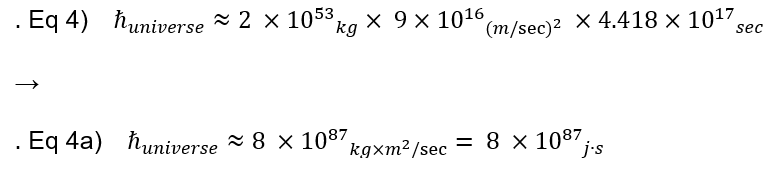
- Δt (Age of the Universe): Approximately 14 billion years ≈ 4.418 x 10¹⁷seconds.
- C (Speed of Light): ≈ 3 x 10⁸m/sec.
- m (Mass of the Universe – Matter only): estimated ≈ 1053kg.
g
The Cosmic Equation:
Substituting these values into the uncertainty principle (at the limit of equality):
Transition to the Quantum Scale
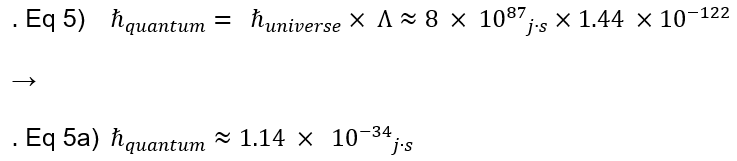
According to the Theory of Spheres, to transition from the cosmic scale to the quantum scale, we apply the geometric coupling constant Λ = 1.44 x 10-122 – derived in Paper II Eq 22:
Using Λ above, The Final Calculation is:
Comparison with Measured Value
The currently accepted value for the reduced Planck constant is:

Conclusion of Calculation:
The derived result is within a deviation of only 8% to 9% from the officially measured value. Given the inherent uncertainties in measuring the mass and age of the universe, this level of alignment strongly suggests that Planck's constant is an emergent property of the our zero-dimensional (0-D) harmonic oscillator framework.
Eran Shimony, 2026 ©
English translation based on the original Hebrew version of the 'Theory of Spheres' (ToS) (2017).
All rights reserved by the author.
To the beginning of the article
Related Papers in the Theory of Spheres Series:
'Theory of Spheres – experiment-proposal'
'Theory of Spheres – Part III'
'Theory of Spheres – Part III(a)'