Originally written April 2023- Revised November, December 2025
Experiment Proposal (Optical)
i(Examining the 'Theory of Spheres' prediction
of a Time-Variable Speed of Light)
Eran Shimony (ORCID number – 0009-0003-5610-6736)
Physicist (B.Sc.), MBA, and Certified Real Estate Appraiser
i
Download the complete research papers in PDF format for offline reading and citation:
[Download Article I: The Framework (PDF)]
[Download Article II: The Spheres Classical components (PDF)]
[ Download Article III: The Quantum–Gravitational Force as Derived from the Spheres (PDF)]
[Paper III(a) – Updated version: The Quantum–Gravitational Force as Derived from the Spheres (PDF)]
[Download Article Ⅳ: The Planck's constant – ℏ (PDF)]
[Download Article VII: Introduction to the New Quantum Geometry Formalism (PDF))]
[Download Article IX: Introduction to the New Quantum Geometry Formalim (PDF))]
s
This Experiment Proposal (Optical) is part of a paer published on December 29, 2025 (DOI: 10.5281/zenodo.18081185).
The empirical validation is presented in the subsequent work: 'Theory of Spheres – Part II', published on February 01, 2026 (DOI: 10.5281/zenodo.18446035)
To prove that the speed of light is not constant over extended periods, as predicted by the 'Theory of the Spheres' (ToS) – a quantum gravity theory, developed by the author, we assume a time-dependent exponential function of the form:
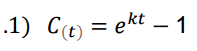
where: C – the speed of light, t – time and k – a constant, determined by initial condition.
Hence, the distance S traveled by light leaving a distant star or quasar, is given by:

(.Where t1 is the time the light left the object, and t2 is the time it is measured by us – Both are measured from the beginning of the time (universe))
To determine the constant – k, we assume the age of the universe is, as is known today, about 14 billion years ( years) and that the known speed of light is about: 300,000 km/s or 1 light years/year.
Received:

Substituting the known age, of the Universe yields the constant k:
K = 0.69314718/(1.4×1010) = 4.95105129E-11 (1/light year)
Hence the real distance in light years of a star (quasar) whose light left about 1.4x 10¹⁰ years ago (the beginning of the universe), as we set t1 = 0, is derived from Equation equation #2, yielding:

Setting: k = 4.95105129E-11 & t2 = 1.4×10¹⁰, in equation #4, and get:

Unlike: 14 billion light years, as is known today (at a constant speed of light).
(T(This indicates the star/quasar is approximately 2.25889 times closer than predicted under the assumption of a constant speed of light or at 44.3% of the constant-speed distance.
Using the well-known inverse-square law for decreased light intensity, it is obtained that the true brightness of the examined quasar will be approximately: 5.1 ≅ 2.252 times lower than expected at a constant speed of light.
As an example, for a speed of light in the past, we calculate the speed of light in about 100,000 years ago.

We get that the speed of light in about 100,000 years ago, based on the distribution assumed in Equation #1, was approximately 2.97 km/s lower than its current speed (300,000 km/s).
Return to the integral in its general form (Equation #2).

In order to measure the real distance of a body, we use the facts that: (t = t2 – t1) and that t2 (the time elapsed since the beginning of the universe), is equal to 1.4X10¹⁰ years, so we get:
As mentioned
t1 is the time, since the beginning of the universe, when the light left the object on its way to us.
&
t2 is the time, since the beginning of the universe, in which light is measured by us .
Substitute in equation #7 and we get:

Then:

Arranging and offset the identical terms (t2) we get:

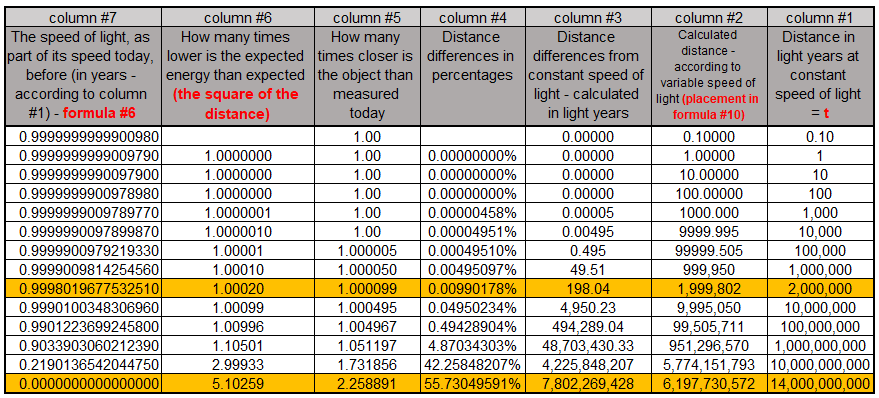
In formula no 10, we place: the constant – k & the known age of the universe – t2 for objects at distances from us equal, at a constant speed of light, to – t (column #1). Then we get for their distance at the variable speed of light, according to the variation we assumed (formula #1), as follows:
Conclusion:
The assumed exponential distribution (Equation #1) for the rate of the speed of light changing over time, implies that: visible objects are closer than expected under a constant speed of light – therefore they possess a lower true (intrinsic) brightness.
This provides an explanation, for example to the high energy of quasars. Objects that according to their Doppler effect (redshift, HR diagram) are expected to be located at an extreme distance – a distance that implies an enormous energy output currently unexplained by the known laws of physics. This explanation is provided without relying on the prevailing assumption that their Doppler effect is caused by a high relative velocity (e.g., ejection from a black hole) since the objects are actually much closer.
Consequently, quasars are closer than expected at a constant speed of light, aligning with the prediction of the (ToS), eliminating the need for contrived alternative theories.
Final note: The exponential distribution assumed for the variation in the speed of light is currently hypothetical – not based on experimental observation. However, this asymptotic model offers a resolution to the Hubble Tension by showing that the discrepancy is a mathematical artifact of forcing a linear fit onto an inherently asymptotic distribution. This explains why, historically, as measurements have extended to greater distances with improved precision, the calculated Hubble constant (H0) has consistently decreased—exactly as predicted by the ToS. As we measure further along the curve, the descending slope naturally deviates from the local linear approximation.
By systematically comparing the: calculated distance (column #2)/true brightness expected (column #6) (derived from a time-varying speed of light) with the expected brightness/distance (column #1) at a constant light speed for numerous objects, at varying distances, we might empirically derive the exact mathematical distribution for the rate of change in the speed of light over time.
Eran Shimony, 2025 ©
English translation based on the original Hebrew version of the Opticl Experiment Proposal (2023).
All rights reserved by the author.